Managing daily orders in the FMCG Order Management Software business is a fast-paced job. Distributors deal with hundreds of retailers, frequent order cycles, changing stock levels, multiple salesmen, deliveries, returns, schemes, and payments. Managing all of this manually through notebooks, spreadsheets, phone calls, or messaging apps can quickly lead to errors and delays.
This is why modern FMCG Order Management Software increasingly use specialised order management software that connects order booking, inventory, billing, delivery, sales force activity, and claims in one integrated connected ERP system.
Why do FMCG Order Management Software Need Order Management Software?
FMCG distribution involves a high volume of transactions, often with small order values and tight delivery timelines. A distributor may receive orders from dozens or hundreds of retailers every day. Tracking these orders manually makes it difficult to know which orders are pending, billed, dispatched, or delivered.
An order management software helps distributors capture orders digitally and move them through the entire fulfilment cycle. Salesmen can collect orders from retailers, the distributor can check stock availability, generate invoices, prepare deliveries, and track outstanding orders from a centralised FMCG distribution software.
Retailer Order Booking Becomes Faster
Traditional order collection often depends on phone calls, WhatsApp messages, handwritten notes, or salesmen returning to the office with order details. This can slow down the process and create data-entry errors.
A retailer order booking app allows sales representatives to place orders directly from the retailer’s location. Product lists, prices, previous orders, available schemes, and other relevant information can be displayed while booking the order.
This makes the ordering process faster and gives distributors a digital record of every order.
For distributors with a large field team, a salesman app can also help standardise the way orders are collected. Salesmen can view retailer information, check previous transactions, record orders, and stay updated without repeatedly calling the office.
Real-Time Stock Visibility Helps Prevent Stockouts
One of the biggest challenges in FMCG distribution is knowing what is actually available for sale.
A retailer may order a product that appears available in records but is already committed to another order. Without accurate inventory information, distributors may accept orders that cannot be fulfilled.
Modern distribution systems provide stock visibility, helping distributors and sales teams understand current inventory levels. Salesmen can use this information while taking orders, while managers can monitor fast-moving and slow-moving products.
Better stock visibility can also support purchasing decisions by showing which products need replenishment and which products are sitting in inventory for too long.
Distributor Billing Software Connects Orders with Invoicing
Once an order is confirmed, the next step is billing. Entering the same order information again into a separate billing system increases the possibility of errors.
Distributor billing software can connect order booking with invoice generation. Once the order is approved, relevant product quantities, prices, discounts, and taxes can flow into the billing process.
This reduces duplicate data entry and helps distributors process a larger number of orders in less time. For FMCG businesses, where margins can be tight and transaction volumes are high, accurate billing is particularly important.
From Delivery Challan to Invoice
FMCG Order Management Software may have different processes depending on their customers, products, and delivery arrangements. In some situations, goods may first move against a delivery document before the final invoice is generated.
A connected system can support the delivery challan to invoice process, allowing distributors to maintain continuity between dispatch documentation and billing.
Instead of managing challans and invoices as completely separate records, the distributor can maintain a digital trail of the transaction. This can make reconciliation easier and improve visibility into goods that have been dispatched but are yet to be invoiced.
Order Collection Software Improves Field Sales Management
For distributors with multiple sales representatives, simply collecting orders is not enough. Managers also need to know how effectively the sales team is covering the market.
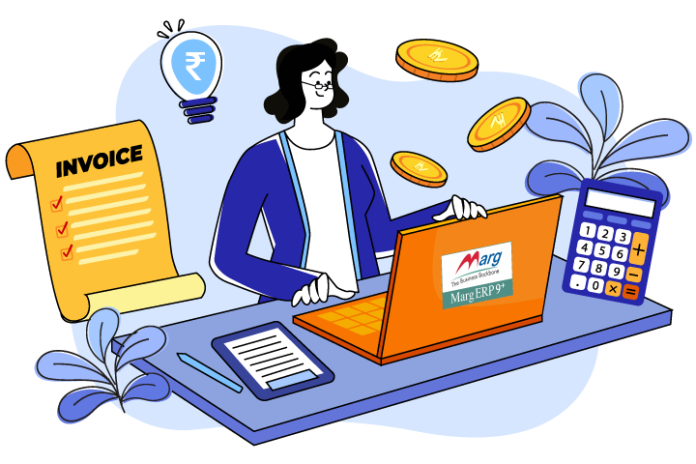
Order collection software like Marg ERP can provide information about retailer visits, orders collected, products sold, order values, and sales activity. Managers can use these insights to identify inactive retailers, monitor territory performance, and understand sales trends.
A salesman app can further simplify field operations by giving representatives access to customer and product information while they are on the move. This creates a more connected workflow between the field sales team and the distributor’s back office.
Distributor Claim Management Reduces Follow-Up Hassles
FMCG distribution often involves schemes, promotional claims, discounts, damaged goods, shortages, expiry-related issues, and other adjustments. Managing these claims manually can make reconciliation difficult.
A system with distributor claim management capabilities can help record claims, maintain supporting information, track their status, and improve visibility into pending settlements.
Instead of relying on scattered documents or conversations, distributors can maintain a structured record of claims and follow-ups.
Why FMCG Distribution Software is Becoming Important.
As a distributor grows, using separate tools for orders, inventory, billing, salesmen, and claims can create information gaps. An FMCG ERP brings these functions together on a common platform.
The objective is not simply to automate billing. It is to connect the complete distribution cycle;
- Retailer Order
- Order Verification
- Stock Check
- Billing
- Delivery
- Payments
- Claims
- Reporting
With this connected approach, distributors can reduce manual work, improve operational visibility, and make faster business decisions.
What Should Distributors Look for in Order Management Software?
FMCG Order Management Software should evaluate whether it can support their actual day-to-day workflow before selecting a billing software for FMCG distribution business. Important capabilities include;
- Digital retailer order booking
- Mobile access for field sales teams
- Real-time stock visibility
- Integrated billing and taxation
- Delivery and dispatch management
- Delivery challan to invoice workflow
- Scheme and discount management
- Distributor claim management
- Salesman performance tracking
- Retailer-wise and product-wise reporting
- Multi-location and multi-user support
- Integration with other business systems
The right system should make daily operations simpler rather than adding another layer of complexity.
Conclusion
FMCG Order Management Software need more than basic billing software to manage today’s high-volume distribution operations. Order management software, retailer order booking apps, salesman apps, stock visibility, billing, delivery, and claim management can work together to create a smoother distribution process.
An integrated FMCG ERP helps distributors save time, reduce errors, improve control, and serve retailers more efficiently.
FAQs on FMCG Distribution Software
Can FMCG distribution software integrate with accounting systems?
Several modern distribution platforms can integrate with accounting applications to synchronise financial and transactional data.
How long does it take to implement an FMCG ERP?
Implementation time varies depending on the distributor’s size, number of users, branches, existing processes, and required integrations.
Is cloud-based software suitable for FMCG distributors?
Cloud-based systems can be useful for businesses that need access to operational information across branches, offices, and field teams.
How secure is data stored in distributor management software?
Security depends on the software provider and its infrastructure. Distributors should evaluate access controls, authentication, backups, encryption, and data-recovery processes before choosing a platform.
Can the FMCG distribution software scale as an FMCG distribution business grows?
A scalable system can support increasing numbers of retailers, products, salesmen, transactions, warehouses, and business locations without requiring a complete change of platform.