

The Drugs and Cosmetics Act, 1940 is the foundation of India’s drug regulation system. It governs the manufacture, sale, storage, distribution, and quality of medicines sold across the country. Even in 2025, it remains the central legal framework that every pharmacy must comply with to ensure safety, transparency, and legal protection.
Over time, technology has played a big role in helping pharmacies remain compliant with these evolving rules, and this is where modern pharmacy software has become essential for smooth operations.
Key Amendments and New Provisions Over the Years
The Act has been strengthened through several amendments to address new challenges, improve quality standards, and enhance accountability across the pharmaceutical supply chain.
The shift towards digital accuracy in dispensing, record-keeping, and stock management has increased the adoption of reliable pharmacy billing software for everyday pharmacy operations.
- Stricter Penalties (Amendment Act, 2008)
This amendment introduced tough penalties for manufacturing spurious, adulterated, or misbranded drugs. Offences now attract higher fines, imprisonment, and cancellation of licences for repeated violations.
The compliance expectations under these laws have encouraged more pharmacies to use retail pharmacy software to maintain error-free records and prevent non-compliant transactions.
- Jan Vishwas (Amendment of Provisions) Act, 2023
A major reform that decriminalised minor offences and replaced many imprisonment clauses with monetary penalties. It also introduced charges for failing to comply with orders from regulatory authorities and strengthened enforcement mechanisms.
This new compliance structure makes it important for pharmacies to use dependable pharmacy shop software that ensures proper documentation, audit trails, and timely updates.
- Clinical Trial Provisions (Amendment Bill, 2013)
This Bill proposed mandatory registration of clinical trials with the Central Drug Authority (CDA), approval from Ethics Committees, and compulsory medical treatment or compensation for individuals injured or killed during a clinical trial.
Such reforms highlight the importance of trusted digital systems, and solutions like the best pharmacy shop software in India help pharmacies stay aligned with evolving regulatory expectations.

- Licensing and Quality Control Requirements
Recent changes to the Drugs and Cosmetics Rules, 1945 require:
- Bioequivalence study submission for certain oral dosage forms
- Joint inspections by Central and State Drug Inspectors before granting a manufacturing licence
- Proven stability and safety of excipients before approval
These provisions aim to strengthen the overall quality and reliability of medicines available in the Indian market.
- Regulatory and Procedural Enhancements
To improve enforcement efficiency, the government has:
- Established special courts in many States/UTs
- Increased sanctioned posts within CDSCO
- Strengthened monitoring systems
- Streamlined offence trials
This modern regulatory environment requires pharmacies to follow strict record-keeping, accurate sales processes, and transparent documentation.
Key Sections of the Drugs and Cosmetics Act, 1940 Relevant for Pharma Industry
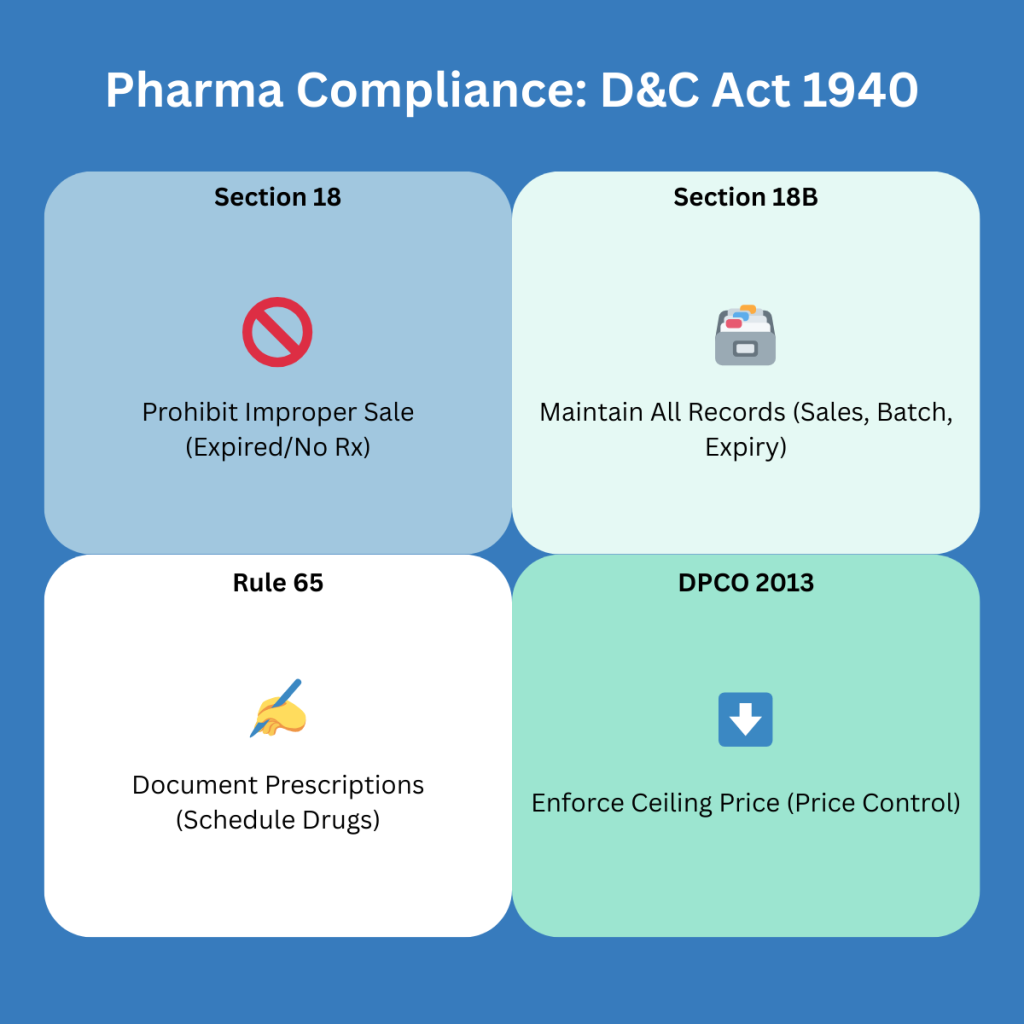
Section 18: Prohibition of Improper Sale
Regulates the sale of misbranded, adulterated, and expired medicines and prohibits dispensing Schedule H, H1, and X drugs without valid prescriptions.
Section 18B: Record Maintenance
Pharmacies must maintain detailed sales, purchase, batch, expiry, and prescription records for inspections.
Rule 65: Retail Sale Conditions
Defines mandatory requirements for prescription entry, doctor details, patient information, and record-keeping for Schedule drugs.
DPCO 2013 Compliance
Prohibits selling scheduled drugs above the government-notified ceiling price. These sections require high accuracy and traceability in pharmacy operations.
How Marg Pharmacy Software Keeps Your Business Compliant?
Marg ERP is built to ensure compliance with every provision of the Drugs and Cosmetics Act, 1940 and later amendments from prescription handling to batch and expiry management. It ensures that pharmacies avoid penalties, pass inspections, and maintain transparent operations.
Key compliance features in Marg Pharmacy Billing Software are;
- Prescription validation for Schedule H/H1/X
- Batch & expiry alerts
- Automatic prevention of expired product billing
- DPCO price compliance
- GST-ready billing
- Digital audit trails
- Complete record-keeping for inspectors
- Licence information storage
- Purchase-to-sale stock reconciliation
Marg Pharmacy Retail Software simplifies regulatory compliance, reduces manual errors, and keeps your pharmacy always inspection-ready.
Conclusion
The Drugs and Cosmetics Act, 1940 continues to evolve with new provisions like stricter penalties, clinical trial safety rules, quality-control mandates, and decriminalisation reforms under the Jan Vishwas Act. As compliance becomes more demanding, pharmacies must transition from manual processes to reliable digital tools.
With built-in legal safeguards, automated checks, and accurate reporting, Marg ERP ensures pharmacies meet every regulation with ease, making operations safe, efficient, and future-ready.
Frequently Asked Questions
Is the Drugs and Cosmetics Act 1940 still applicable in 2025?
Yes, it remains India’s primary law governing drugs and cosmetics.
What does the Jan Vishwas Act 2023 change?
It decriminalises minor offences and introduces financial penalties.
Are Schedule H and H1 drugs sold only with a prescription?
Yes, and pharmacies must record doctor and patient details.
Why are joint inspections now mandatory?
To ensure uniform quality before issuing manufacturing licences.
How does Marg help with compliance?
By automating expiry checks, prescription validation, batch tracking, and audit-ready reporting.